
The Structure of Life: A Structural Reading of Katakamuna Verse 11 Through the Lens of Similarity
An Interpretive Account of Human Life as Analogous Structure within the ISR/VPR Framework
Abstract
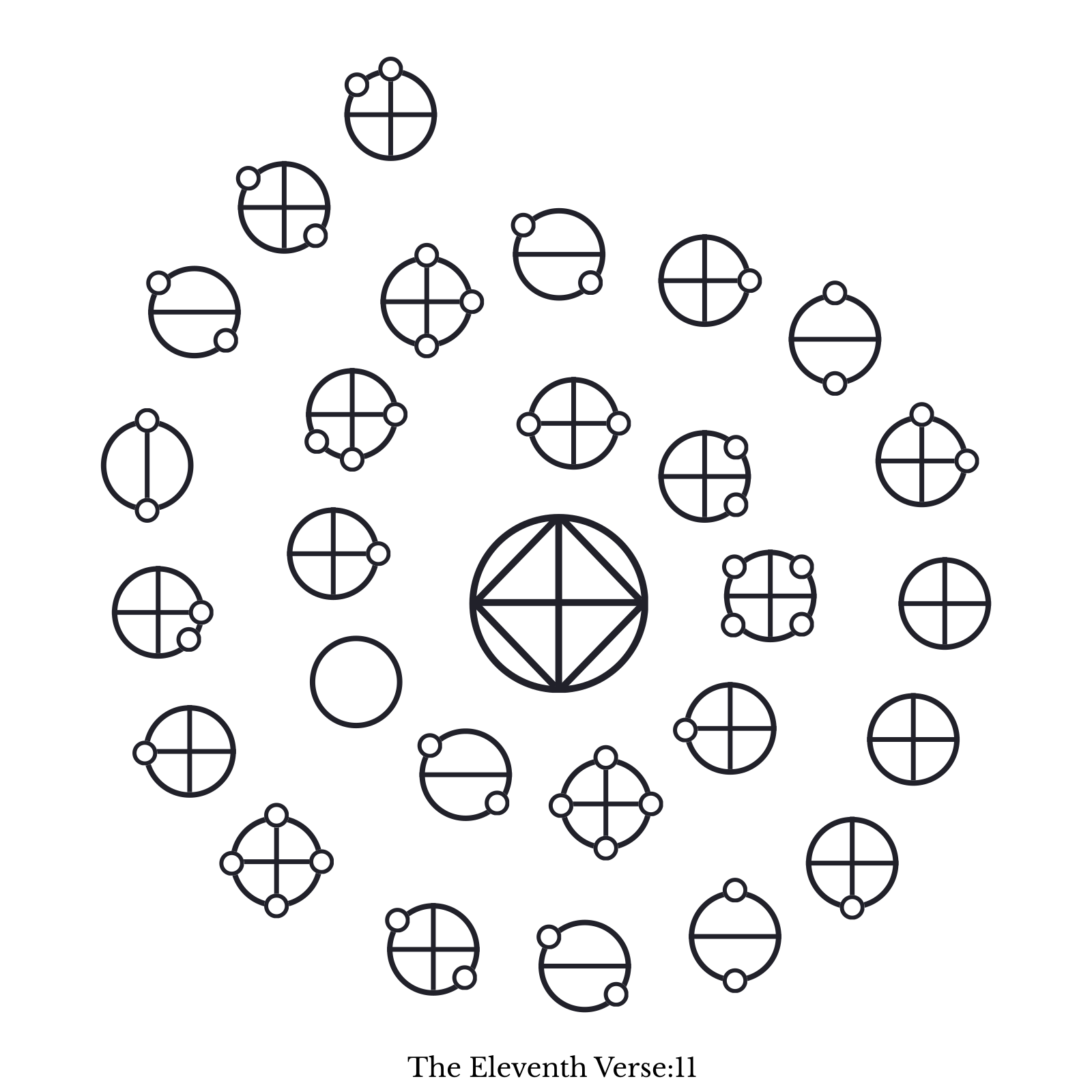
KA-TA KA-MU-NA A-MA NO HI-TO TA-MA
KA-MI SA-KI SA-TO-RI NI-NA TA-MA
NO WA-KE TSU-MI I-KI KO-TO MA-RI NO WA-KE YO-MI Acoustic Protocol (Romanized)
Ee-Hah · Foo-Toh-Yah · Neh · Ee-Kee · Tsoo-Chee · Noh · Wah
Kah-Tah · Kah-Moo-Nah · Ah-Mah · Noh · Hee-Toh · Tah-Mah
Kah-Mee · Sah-Kee · Sah-Toh-Ree · Nee-Nah · Tah-Mah
Noh · Wah-Keh · Tsoo-Mee · Ee-Kee · Koh-Toh · Mah-Ree · Noh · Wah-Keh · Yoh-Mee
This is a structural interpretive attempt — an application of the principle of structural similarity to the Katakamuna sonic elements. It is not a claim that Katakamuna was composed with modern biological knowledge. It is a claim that the sonic elements, read through their geometrical structure and the meanings preserved in modern Japanese, yield a coherent account of life. Propositions requiring further support from subsequent Verses are identified in the full paper.
1. I HA · FU TO YA · NE — The Latent Mechanism of Life
I HA: the bipolar structure of life — the structural precondition of life itself. A nominal concept: not a process but a condition.
Structural similarities: DNA double helix; cell membrane (hydrophilic/hydrophobic bipolar structure); excitatory/inhibitory synaptic balance; cardiac systole and diastole; cellular Na⁺/K⁺ electrical potential.
2. I KI · TSU CHI · NO · WA — The Constitution of the Body
TSU CHI: individual, particle-like entities persisting (CHI). TSU names individual, discrete entities at any scale: elementary particles at the quantum scale; cells and organs in living systems; stars and planets at the cosmic scale. In this context: individual cells and organs operating continuously without conscious direction.
WA: integration, harmony, circle — the unified whole.
I KI · TSU CHI · NO · WA: the life force arises; individual cells and organs persist; their harmonious integration constitutes the body.
3. KA TA KA MU NA — The Source of All
The central term of Verse 11. As established across KV-01 through KV-10, KA TA KA MU NA names the source and governing action of all that has been described. Here, it names the living body — I KI · TSU CHI · NO · WA — as the action of the same source that generates the cosmos.
4. A MA NO HI TO TA MA — The Individual Human in the VPR
HI TO: Numeral 1 (HI) that has integrated (TO) — the one that has become a unified, independent individual. The modern Japanese hito (人): person.
TA MA: that which MA (field, spacetime) has established as an independent phenomenon (TA). Every phenomenon is a TA MA. Here: the individual human being as a bounded, independent presence within the VPR.
A MA NO HI TO TA MA: the individual human being — one unified presence within the VPR.
5. KA MI · SA KI · SA TO RI
SA KI: from the difference (SA) within KA MI, KI — arising, generation — occurs. The SA established in IVRP-04 as the initiating principle appears here in the context of life.
SA TO RI: the removal (TO RI) of difference (SA) — the process of resolution toward a stable state. At the physical scale: the removal of asymmetry between matter and antimatter produced the stable material world. At the scale of living consciousness: the resolution of inner asymmetry produces clarity, awareness, awakening. Preserved in satori (悟り): enlightenment.
6. NI NA · TA MA · NO · WA KE · TSU MI
TA MA: the individual bounded presence.
WA KE · TSU MI: individual particle-like presences (TSU MI) that have taken on unified manifest form (WA KE) — cells and organs constituting a single living body. Each such body is one human being.
7. I KI · KO TO · MA RI · NO · WA KE · YO MI
KO TO: the continuation of life activity. Preserved in the modern Japanese koto (事): a continuing state of affairs.
MA RI: the field (MA) that has separated and become independent (RI) — a sphere (mari, 鞠). The living body as an independent, bounded presence within spacetime.
WA KE: the mechanism, the reason.
YO MI: to read, to perceive, to know.
I KI · KO TO · MA RI · NO · WA KE · YO MI: to perceive and know the mechanism by which life activity continues within the independent, bounded presence that is the living body.
© 2026 Jinco K. | J-Katakamuna Research | All Rights Reserved.