
The Origin of Electric and Magnetic Quanta: The Materialisation Process from ISR to VPR and the Generation of Quadriphasic Particles
A Structural Reading of Katakamuna Verse 12
Abstract
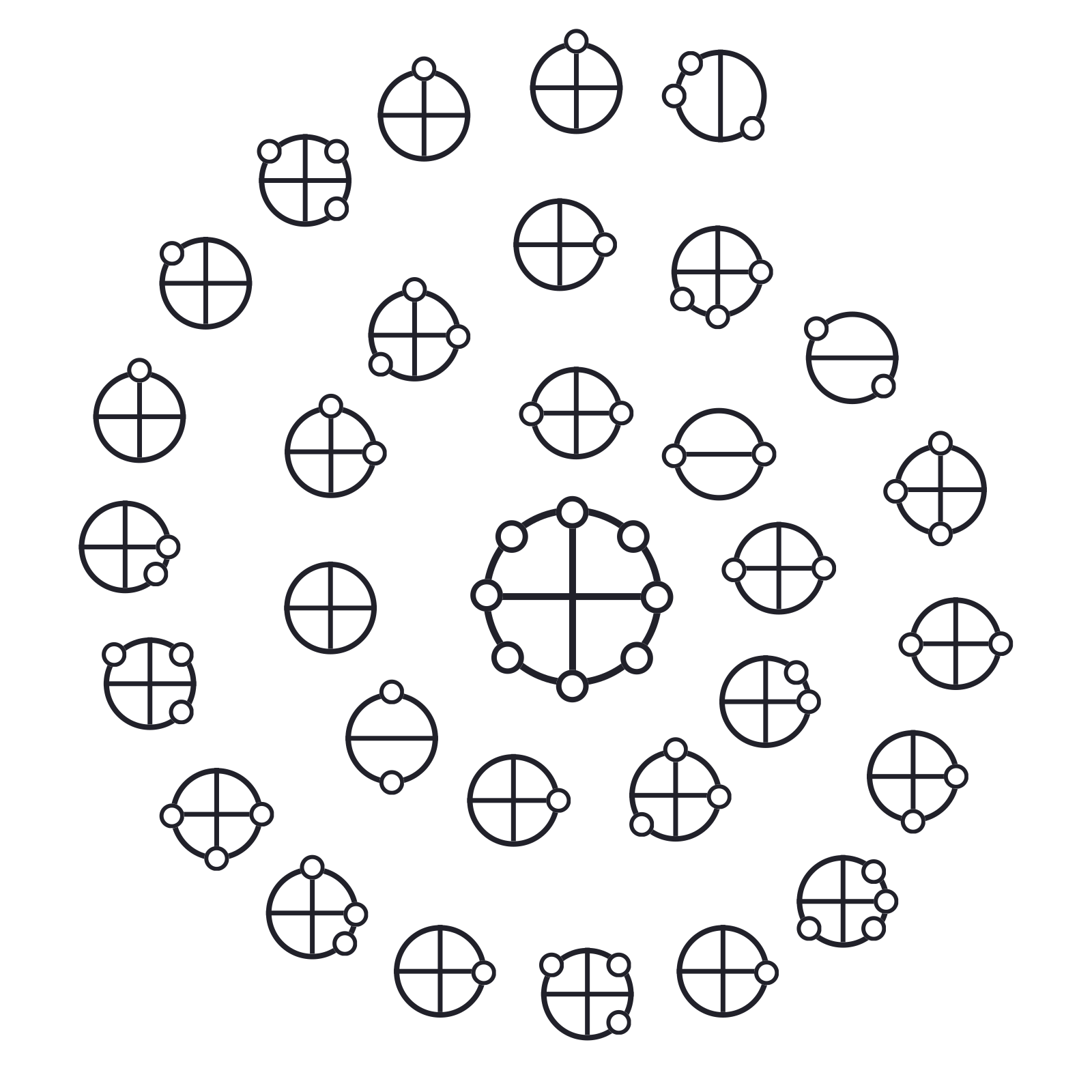
KA-MU-MI KA-TA KA-MU-NA NO MI-SO-TE HO-TO
A-O KO-KO-RO A-KA KU-SU-BE A-KA MI-KO-TO
HA-NA KU-SU-BE KO-TO MI-CHI TO-YO KU-SU-BE
MI-CHI U-TA SI-ME-SI Acoustic Protocol (Romanized)
See-Hee · Hah-Tah · See-Hee · Foo-Mee · Kah-Moo-Mee · Ah-Kee · Tah-Mah · Toh · Ah-Oo
Kah-Moo-Mee · Kah-Tah · Kah-Moo-Nah · Noh · Mee-Soh-Teh · Hoh-Toh
Ah-Oh · Koh-Koh-Roh · Ah-Kah · Koo-Soo-Heh · Ah-Kah · Mee-Koh-Toh
Hah-Nah · Koo-Soo-Heh · Koh-Toh · Mee-Chee · Toh-Yoh · Koo-Soo-Heh
Mee-Chee · Oo-Tah · See-Meh-See
The central question this reading addresses is not what is observed, but why it is so — what background mechanism and law produces the observed facts of electromagnetism, electroweak unification, and quantum duality. Modern physics describes these facts with precision. This reading proposes a structural suggestion about what lies behind them, drawn from the sonic elements of Katakamuna. It is offered as suggestion to future investigators.
1. SI HI · HA TA · SI HI · FU MI · KA MU MI · A KI · TA MA · TO · A U
HA TA: the state in which positive and negative have come into affinity and arisen.
SI HI (second occurrence): the HI that is shown but invisible — the ISR-side root numeral one. The double appearance of SI HI names the duality: VPR-side (the visible phenomenon) and ISR-side (the invisible operative force).
FU MI: two (FU, numeral 2) quanta arising from the affinity of positive and negative.
KA MU MI: the ISR particle (established in KV-11).
A KI · TA MA · TO · A U: KA MU MI acts upon already-materialised elementary particles and, through interfacial merging, generates counter-generation. This process is the background condition that sustains material existence as material.
2. KA MU MI · KA TA · KA MU NA · NO · MI SO TE · HO TO
3. A O · KO KO RO — The Magnetic Quantum
KO KO RO: repeating, repeating, endlessly entangling and clinging — the quantum that ceaselessly, repeatedly entangles. This reading defines KO KO RO as the magnetic quantum.
The thought-image of RO — entangling, clinging — corresponds structurally to the property of magnetic field lines, which always form closed curves. Why do magnetic field lines form closed curves? This reading proposes the ceaseless entangling action of the ISR component as the background mechanism.
4. A KA · KU SU BE — The Electric Quantum
KU SU BE: freely advancing, with directionality and mechanism — the mechanism by which the force advances freely in diverse directions.
Why does the electric force act freely in diverse directions? This reading proposes that A KA generates its diverse directionality through the KU SU BE mechanism.
5. A KA · MI KO TO · HA NA · KU SU BE
The structure of HA NA corresponds structurally to the pair-production and annihilation of electrons and positrons. Why does pair-production of positive and negative occur? This reading proposes the counter-generation of ISR and VPR as the background mechanism.
6. KO TO · MI CHI · TO YO · KU SU BE
MI CHI: the persistent sustaining of MI — principle and law.
TO YO: by the interference of ISR and VPR, the quadriphasic nature — particle-like, wave-like, contracting, expanding.
KU SU BE: the mechanism of free, diverse advance.
Why do elementary particles simultaneously possess particle-like and wave-like nature? This reading proposes the quadriphasic nature (TO YO) — arising from the interference of ISR and VPR — as the background of this duality.
7. Electroweak Unification — A Structural Correspondence
Modern physics has demonstrated through electroweak unification theory that electromagnetism and the weak nuclear force share a common source. In this reading, the magnetic quantum (KO KO RO) and the electric quantum (A KA) are described as a pair within Verse 12. This paired description corresponds structurally to the unified source that electroweak theory identifies. Why can electricity and magnetism be unified? This reading proposes the counter-generation of ISR and VPR — from which both A KA and KO KO RO arise — as the background of their common source.
8. MI CHI · U TA · SI ME SI
MI CHI: the persistent sustaining of MI — principle and law. U TA: as song, as poem. SI ME SI: shown here.
Verse 12 closes: the principle and law are presented here as song. Modern physics describes what occurs with precision. This reading proposes why it is so — the background mechanism — as structural suggestion. That is what is presented here as song.
© 2026 Jinco K. | J-Katakamuna Research | All Rights Reserved.