
The Formation of the Atom: From the Action of KU HI to the Emergence of Atomic Structure
A Structural Reading of Katakamuna Verse 13
Abstract
Katakamuna Verse 13 is read here as a structural account of the process from the action of KU HI to the formation of the atom. The root force advances dynamically (SU HI · CHI NI), and through the action of KU HI — which clings to phenomena like seaweed, fixing and confirming their existence — mass arises (O MO TA RU · I MO). Wave-like nature and particle-like nature then emerge (I SA NA MI · I SA NA KI), followed by the quadriphasic action of TO YO, the electron shell (KA FU SHI NU), and the existence of matter in cosmic space (U KI FU NU). The Verse closes with the formation of the atom as a unified, self-contained structure (MA KA · HA KO · KU NI). A key structural suggestion: mass arises first, and wave-like and particle-like nature follow as its consequence.
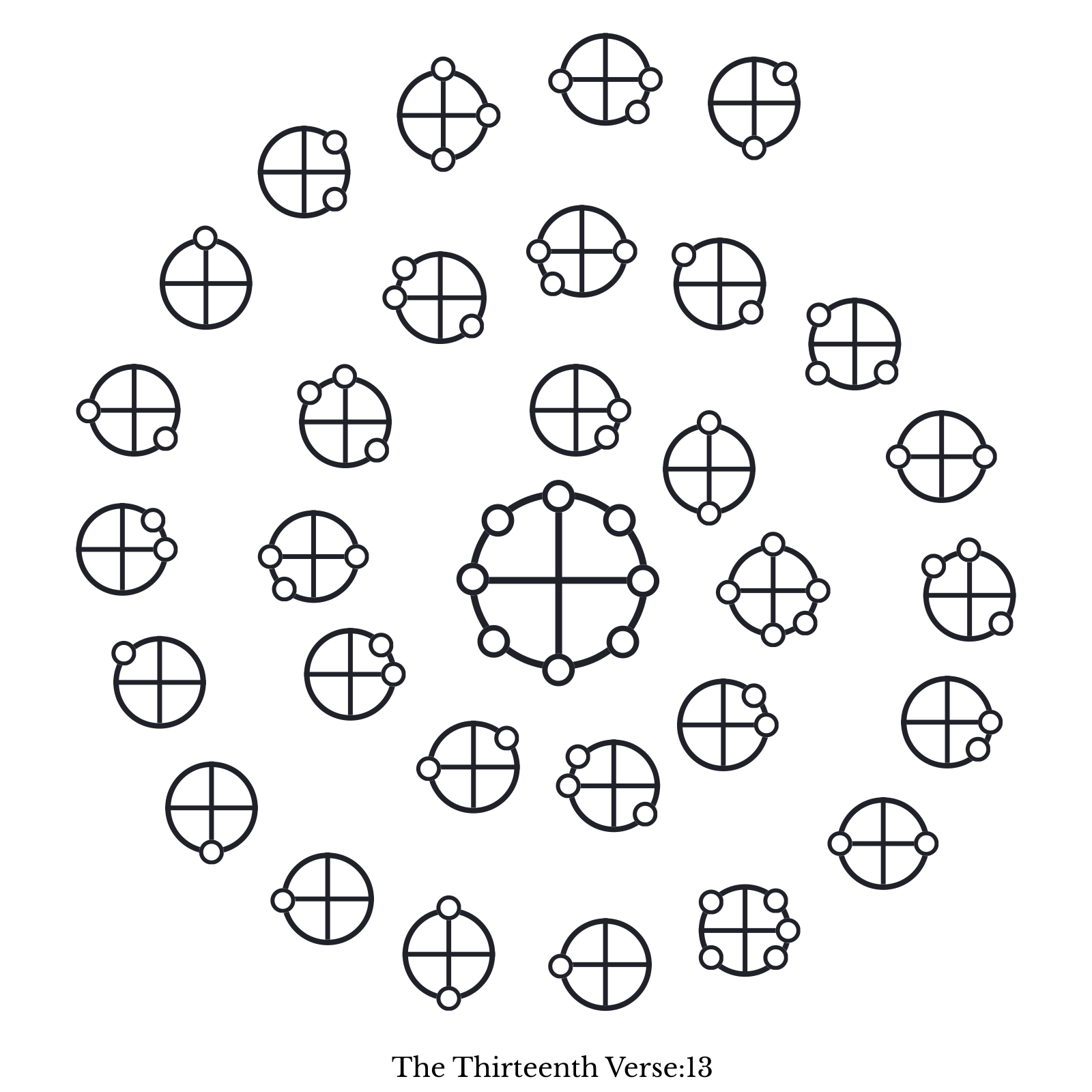
SU-HI CHI-NI TSU-NU KU-HI I-MO I-KU KU-HI
O-HO TO-NO-CHI I-MO O-HO TO-NO-HE
O-MO TA-RU I-MO A-YA KA-SHI KO-NE
I-SA NA-MI I-SA NA-KI TO-YO KA-FU SHI-NU
U-KI FU-NU MA-KA HA-KO KU-NI Acoustic Protocol (Romanized)
Soo-Hee · Chee-Nee · Tsoo-Noo · Koo-Hee · Ee-Moh · Ee-Koo · Koo-Hee
Oh-Hoh · Toh-Noh-Chee · Ee-Moh · Oh-Hoh · Toh-Noh-Heh
Oh-Moh · Tah-Roo · Ee-Moh · Ah-Yah · Kah-Shee · Koh-Neh
Ee-Sah · Nah-Mee · Ee-Sah · Nah-Kee · Toh-Yoh · Kah-Foo · Shee-Noo
Oo-Kee · Foo-Noo · Mah-Kah · Hah-Koh · Koo-Nee
★ A Note on This Reading
This is a structural interpretive reading. The central suggestion — that mass arises first and wave-particle duality follows as its consequence — addresses one of the unresolved questions of modern physics and is offered as suggestion to future investigators. The KU HI action is proposed as a structural analogue of the Higgs field, not as its identification.
1. SU HI · CHI NI · TSU NU · KU HI — The Advance of the Root Force
The Root Force and KU HI
SU HI: the root numeral one (HI) advancing dynamically and developing through 1 → 2 → 3 → 4 → 5.CHI NI: the root force settling persistently into the phenomenal world.
TSU NU: an invisible force acts upon all individual, particle-like phenomena.
KU HI: the freely acting root force — KU HI. This action corresponds structurally to the description of the Higgs field as a field that permeates all of space and clings to particles, slowing them and giving them mass.
2. I MO · I KU · KU HI — Clinging and Confirming Existence
Clinging Like Seaweed
I MO: the force clings to the phenomenon (I) like seaweed (mo, 藻).I KU: the phenomenon is confirmed in existence — made to live (iku, 生く). By being clung to and fixed, its presence becomes definite.
KU HI: this action is KU HI itself.
The thought-image of mo (seaweed) — clinging, wrapping, holding — is the central image of this passage. The modern Japanese imo (芋, potato) — a rounded body wrapped within the earth — carries a structural resonance with this reading.
3. O HO · TO NO CHI · I MO · O HO · TO NO HE — Direction and Persistence
Temporal Persistence and Spatial Directionality
In the six-directional positive-negative affinity environment (O HO), the interference of ISR and VPR produces persistence (TO NO CHI) and directionality (TO NO HE).TO NO CHI: temporal persistence — the phenomenon continues through time.
TO NO HE: spatial directionality — the direction of development is determined.
These two properties — persistence and directionality — are established by the interference of ISR and VPR within the clinging action of I MO.
4. O MO · TA RU · I MO — The Generation of Mass
O MO TA RU — Heavy-Borne
O MO · TA RU: in the six-directional field, seaweed clinging (O MO), arriving in the phenomenal world (TA RU).I MO: the phenomenon with seaweed clinging — omotaru (重もたる): heavy-borne. By the clinging action, the quality of heaviness — mass — has been acquired.
I MO is the minimal unit of material formation bearing mass through the KU HI action. The modern Japanese omoi (重い, heavy) and imo (芋, potato — a rounded body held within the earth) both carry structural resonances with this reading.
5. A YA · KA SHI · KO NE — The Root of the Cosmos
Surrounding the Entire Cosmos
A YA: the critical point of ISR and VPR — surrounding the entire cosmos. Corresponds structurally to the Higgs field as pervading all of space.KA SHI: the root force is shown.
KO NE: infinitely repeating, becoming the foundational root. Preserved in the modern Japanese ne (根, root).
6. I SA · NA MI · I SA · NA KI — Wave-Like and Particle-Like Nature
A Key Structural Suggestion
I SA · NA MI: from the minute difference (SA), wave-like nature arises. Preserved in the modern Japanese nami (波, wave).I SA · NA KI: from the minute difference (SA), particle-like nature arises. Preserved in the modern Japanese nagi (凪, the stilling of waves — fixed, settled).
In this reading, mass arises (O MO TA RU) before wave-like and particle-like nature are described (I SA NA MI · I SA NA KI). This ordering proposes a direction of causality: mass is the prior condition from which wave-like and particle-like nature emerge. Why mass-bearing particles simultaneously possess both natures is an unresolved question in modern physics. This reading proposes the generation of mass as the background of that duality.
7. TO YO · KA FU · SHI NU — Quadriphasic Nature and the Electron Shell
TO YO and KA FU SHI NU
TO YO: by the interference of ISR and VPR, the quadriphasic nature — particle-like, wave-like, contracting, expanding. Including the positive and negative of the electron and positron. The modern Japanese toyo (豊, abundant) carries a structural resonance — the four phases acting in abundance.KA FU · SHI NU: the two-fold action of the root force (positive and negative, yin and yang) shown but invisible — covering the outer surface. The modern Japanese kaburu (被る, to be covered) connects directly. KA FU SHI NU describes the electrons of the electron shell — covering the nucleus invisibly from the outside.
8. U KI · FU NU — Existence in Cosmic Space
Floating in Cosmic Space
U KI: arising from the ISR/VPR boundary. The modern Japanese uki (浮き, floating) — the condition in which matter formed in cosmic space remains and persists there. Not merely floating in gravity or water, but the structural condition of matter existing in the zero-gravity of cosmic space.FU NU: retaining the positive-negative, yin-yang quality as an invisible foundational property.
9. MA KA · HA KO · KU NI — The Formation of the Atom
HA KO KU NI — The Atom
MA KA: by the action of the root force within spacetime.HA KO: positive-negative counter-generation repeating (Numeral 9). The modern Japanese hako (箱, box) — a gathered, bounded mass.
KU NI: settling freely and naturally as a unified whole. The modern Japanese kuni (国, country) — a single bounded unity.
HA KO KU NI: through repeated positive-negative counter-generation (HA KO), settling freely and naturally as a unified whole (KU NI) — the proton, neutron, and electron combined into the atom. The combination of these two everyday Japanese words — box and country — naming the atom as a self-contained, unified structure is among the most direct examples of the Katakamuna-Japanese connection in the Verse series.
© 2026 Jinco K. | J-Katakamuna Research | All Rights Reserved.