
MIKOTO — Life Arises from the Same Root as the Physical World
A Structural Reading of Katakamuna Verse 03
Abstract
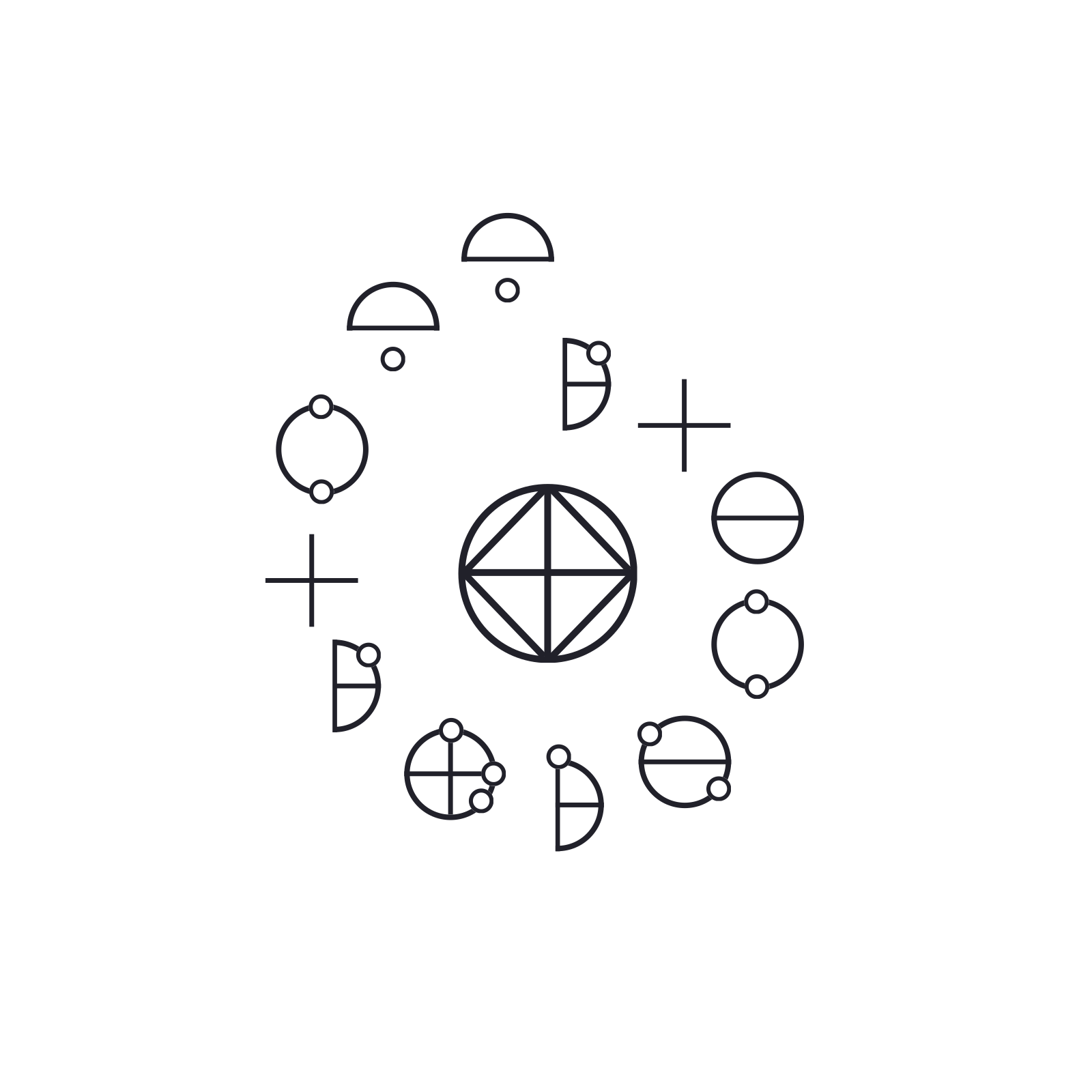
Foo-Toh-Tah-Mah · Noh · Mee · Mee-Koh-Toh · Foo-Toh-Mah-Nee · Nee
MIKOTO is written in Katakamuna as a single Compound Glyph (CG) — MI, KO, and TO integrated into one figure. The connection between MIKOTO and the Japanese word for life (mikoto, 命) is offered as structural suggestion: the Katakamuna concept first, the Japanese vocabulary as inheritance.
Introduction: Where Life Enters
Verse 01 established the primordial resonance (HI BI KI) from which phenomena arise and the permanent ISR/VPR connection (U TSU SHI MA TSU RU). Verse 02 established KAMI — the Compound Glyph that names the root of all individual existence in the VPR. Verse 03 follows immediately.
Modern science has developed physics and life science as separate disciplines. Elementary particle physics investigates the minimal units of matter; life science investigates DNA, cells, and metabolism. The boundary between them is deep. Katakamuna does not hold this boundary. The root mechanism described in Verses 01 and 02 appears directly in Verse 03 as the description of life — readable as structural design, not coincidence: in Katakamuna, the physical and the living share a single origin and a single principle.
Phase 1 — FU TO TA MA : The Spherical Individual Entity
TO: integration, arrival at completion; the crossing and unification of ISR and VPR.
TA: arising as an independent presence in the VPR.
MA: spacetime; the field of time and space.
FU TO TA MA: the two opposing forces of ISR and VPR integrated into a completed form (FU TO), arising as an individual presence in spacetime (TA MA). The modern Japanese tama (玉, sphere) connects directly — the spherical form that rotating bodies naturally assume: planets, stars, atoms, cells.
The scope of FU TO TA MA is as broad as KAMI in Verse 02: planets, atoms, cells — all individual entities that have settled in the VPR as bounded spherical presences. The root (KAMI) and the form it takes (FU TO TA MA) are the same structural category, read from different angles.
Phase 2 — MIKOTO (CG) : The Condition of Life
MI: the realised entity; the substantial body.
KO: ceaselessly, without interruption.
TO: the counter-generative interaction of ISR and VPR.
MIKOTO: the substantial body (MI) acquires life only through the ceaseless (KO) counter-generative interaction of ISR and VPR (TO).
The limiting condition is structural. Life is not a static state. It is a dynamic process that holds only as long as the ISR/VPR interaction continues without interruption. When that interaction ceases, MIKOTO — life — does not hold.
The modern Japanese mikoto (命, life, vital principle): the Katakamuna concept MIKOTO is read here as the source from which this Japanese word derives. This is offered as structural suggestion.
Phase 3 — FU TO MA NI · NI : The Universal Principle of Existence
FU TO MA NI is not a description of a particular entity but of the operative background principle — the law by which all existence in the VPR is structured. Nothing that exists in the VPR falls outside this principle. There is no existence beyond FU TO MA NI.
NI (second): by this operative principle (FU TO MA NI), existing with certainty — an emphatic confirmation.
FU TO MA NI · NI: by the principle through which the two opposing forces, integrated into a completed form, settle with certainty into spacetime (FU TO MA NI) — existing (NI).
© 2026 Jinco K. | J-Katakamuna Research | All Rights Reserved.