
The Song of Katakamuna — Primordial Resonance and the Emergence of the Phenomenal World
A Structural Reading of Katakamuna Verse 01
Abstract
A-SHI A-TO U-A-N U-TSU-SHI-MA-TSU-RU
KA-TA-KA-MU-NA U-TA-HI Acoustic Protocol (Romanized)
Kah-Tah-Kah-Moo-Nah · Hee-Hee-Kee · Mah-Noh-Soo-Heh-Shee
Ah-Shee · Ah-Toh · Oo-Ah-N · Oo-Tsoo-Shee-Mah-Tsoo-Roo
Kah-Tah-Kah-Moo-Nah · Oo-Tah-Hee
This is a structural interpretive reading. The connections proposed between Katakamuna sonic elements, modern Japanese words, and structural concepts from modern physics are offered as suggestion. The validity of this reading is independent of the historical origin of the Katakamuna corpus.
Introduction: Two Realms and Two Directions
Katakamuna describes the cosmos as the superposition of two inseparable realms.
The invisible source realm. The non-local background from which all phenomena arise — not directly observable, but readable through the structure of everything that appears in the VPR.
VPR — Visible/Phenomenal Realm (現象界)
The observable world of phenomena. The realm of material existence in spacetime — the domain that modern physics describes with extraordinary precision.
Every structural reading in the Katakamuna Verse series is a reading of the interaction between these two realms: from the ISR toward the VPR, from the source toward the visible.
Modern physics proceeds from observed phenomena toward underlying principles — from the visible toward the source. The history of science is a history of this direction.
Katakamuna proposes the reverse: beginning at the source, tracing the process by which phenomena arise in the visible world.
This is not a criticism of modern physics. It is a suggestion that these two directions may one day converge into a single account of reality.
The Opening Declaration — KA TA KA MU NA
Phase 1 — HI HI KI : Primordial Resonance
HI → BI (second): HI with a voiced consonant marker, becoming BI — countless HI. The root numeral one multiplying into an innumerable multitude.
KI: the character of two VPR lines split apart — phenomena arising in the VPR.
HI BI KI: the root numeral one (HI) multiplying into countless vibrations (BI), from which phenomena arise in the VPR (KI).
The modern Japanese hibiki (響き): resonance, vibration, reverberation. The direct sonic connection between HI BI KI and the modern word for resonance is among the most immediate in the Verse series. HI BI KI names the primordial vibration from which the visible world arises.
Phase 2 — MA NO SU HE SHI : Unfolding Through Spacetime
NO: of, within — locating what follows within spacetime.
SU: advancing, proceeding, generating.
HE: toward a direction; with directionality.
SHI: shown, indicated; made manifest.
MA NO SU HE SHI: within spacetime (MA NO), generating and advancing (SU), with directionality (HE), shown as manifest (SHI). The primordial resonance of HI BI KI unfolds through spacetime with structural direction — not dispersing randomly, but proceeding with the orderly quality of subeshi (統べし): spreading everywhere, governing all.
Phase 3 — A SHI · A TO · U A N : The Confirmation of ISR-Derived Presence
A SHI: the ISR-derived component (A) is shown (SHI) — appearing as a manifest presence.
A TO: further, through integration (TO) — the crossing and unification of ISR and VPR.
U: arising from the ISR/VPR boundary.
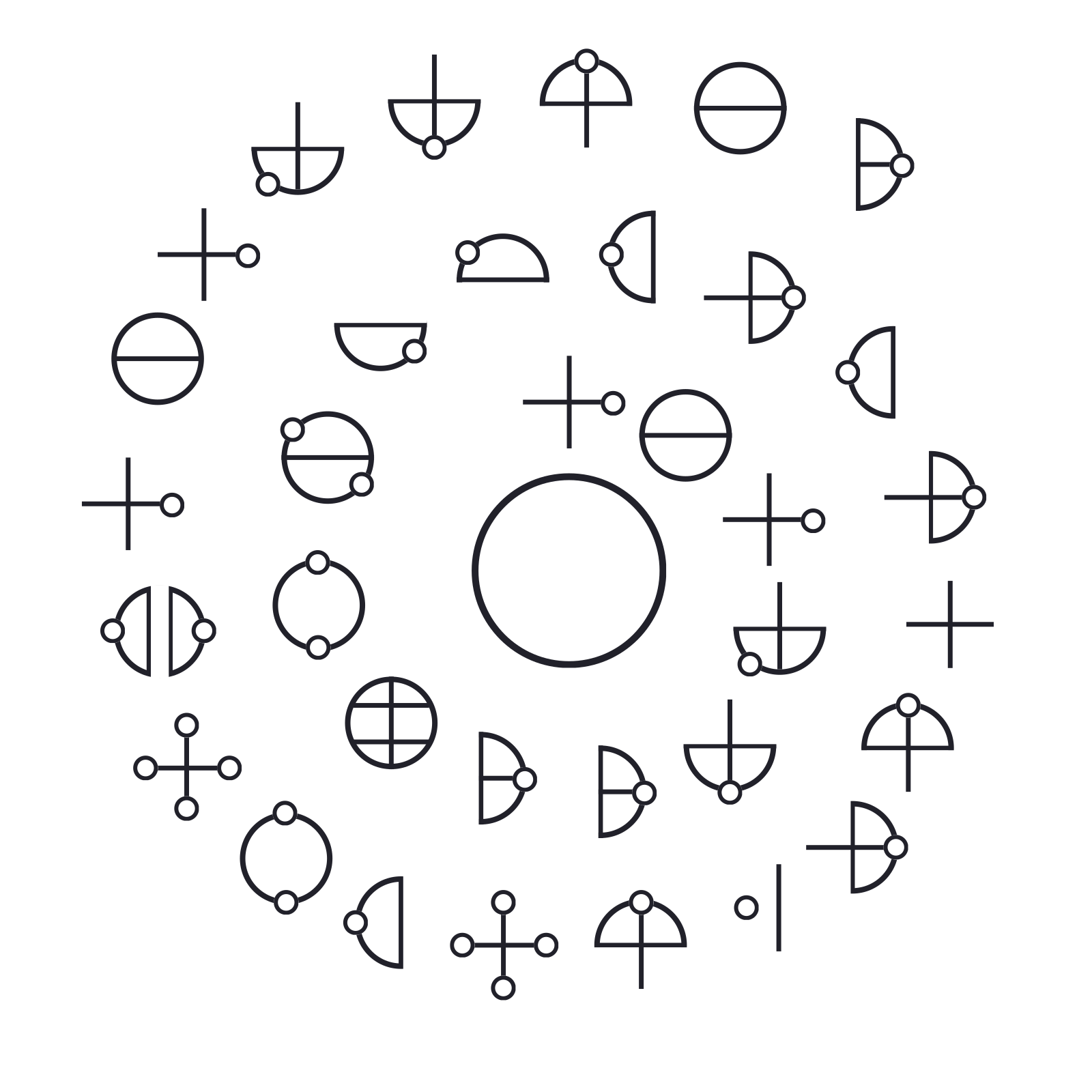
A NU: the ISR-derived component (A) having its existence confirmed and settled (NU). The geometrical character NU: no large circle; an ISR-symbolising vertical line; a small circle at the Numeral 5 position — the condition in which something sourced from the ISR settles and completes its presence in the VPR.
A SHI · A TO · U A N: the ISR-derived component appears (A SHI), is integrated through the ISR/VPR crossing (A TO), and — arising from that boundary (U) — its existence in the VPR becomes confirmed and complete (A NU).
Phase 4 — U TSU SHI MA TSU RU : Projected and Perpetually Connected
MA: within spacetime.
TSU RU (matsuru): the character RU carries a specific geometrical structure — a right half-circle (ISR) and a left half-circle (VPR) split apart by the ISR-symbolising vertical line, with a space between them: the window of the ISR is always open. TSU RU names this condition: always connected to the ISR, without interruption.
The modern Japanese matsuru (祀る, 祭る): to worship, to hold a festival, to maintain connection with the divine. In ancient Japanese culture, the festival (matsuri) was the ritual through which the human world (VPR) maintained its connection to the divine realm (ISR). Katakamuna describes this not as ritual but as structural fact: the connection between VPR and ISR is the permanent condition of all phenomena.
U TSU SHI MA TSU RU: projected from the ISR into the VPR (U TSU SHI), within spacetime (MA), remaining perpetually connected to the ISR (TSU RU).
The Closing Declaration — KA TA KA MU NA · U TA HI
U TA HI: song, poem, chant — the utahi. What begins here is the Song of Katakamuna. The eighty songs that follow are all U TA HI: structural accounts of the cosmos offered in the form of song. The form of utterance is itself part of the meaning — not a technical specification, but a structural account offered for recognition.
Verse 01 closes not with a conclusion but with a declaration. Everything described between the two appearances of KA TA KA MU NA — HI BI KI · MA NO SU HE SHI · A SHI A TO U A N · U TSU SHI MA TSU RU — is the Song of Katakamuna.
© 2026 Jinco K. | J-Katakamuna Research | All Rights Reserved.