
Geometric Elements

Geometric Element

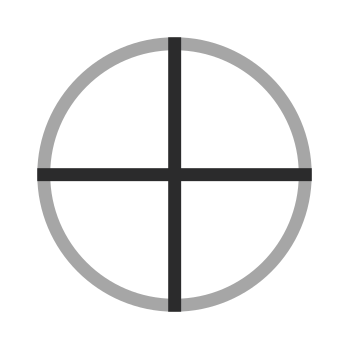
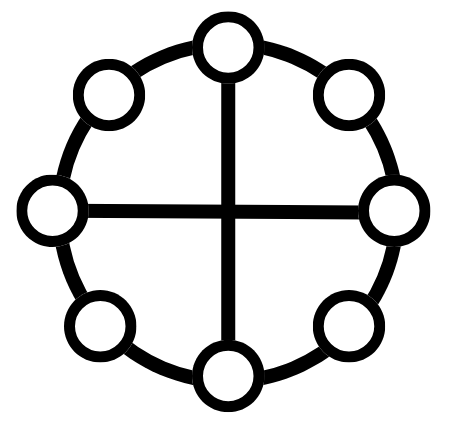
Katakamuna characters are composed of 21 fundamental geometric elements: vertical lines, horizontal lines, a central large circle, and eight peripheral small circles. Each element carries a specific structural meaning that determines its function within the system.

To analyze Katakamuna, two approaches are used in combination:
1. Structural Analysis: Logical examination of geometric form and its defined meaning.
2. Pattern Recognition: Identifying structural relationships across elements and across domains.

This section provides a systematic reference for the 21 elements. Familiarity with these elements is the necessary foundation for working with the 48 Sonic Elements and the 80 Verses.

The Concepts of Ama and Kam

These 21 elements describe a binary structure: Kam (the latent dimension) and Ama (the phenomenal dimension).

Ama

The phenomenal world perceptible through the five senses. It encompasses the observable matter described by modern physics, as well as dark energy and dark matter — phenomena that remain incompletely explained.

Kam

The latent dimension existing prior to form. Described in Katakamuna as the source of matter and energy — a domain that current scientific instrumentation does not yet directly access.

Katakamuna describes these two dimensions as existing in continuous interaction. The geometric elements encode this relationship structurally. Understanding them is the prerequisite for reading the 48 Sonic Elements that follow.

From geometric structure to sonic resonance — the analysis proceeds in sequence.
1

1. Vertical Line

Shape: Vertical line
Symbol: KAMU
2

2. Horizontal Line

Shape: Horizontal line
Symbol: AMA
3

3. Circle

Shape: Complete circle
Symbol: Unified whole
4

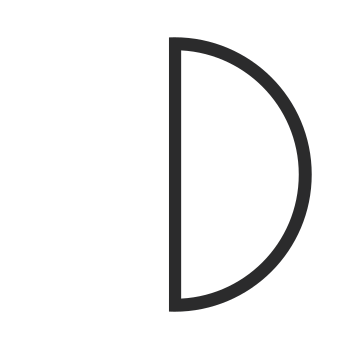
4. Right Semicircle

Shape: Opening to the right
Symbol: KAMU
5

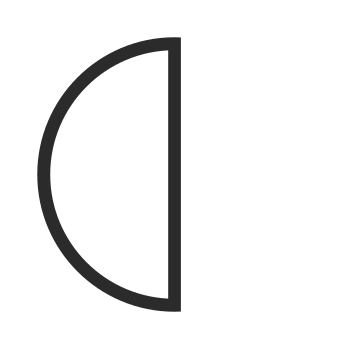
5. Left Semicircle

Shape: Opening to the left
Symbol: AMA
6

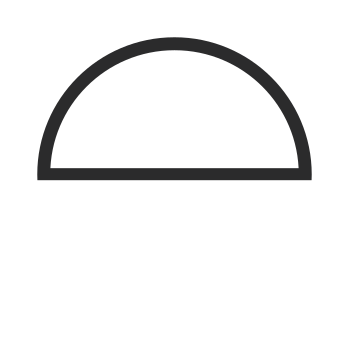
6. Upper Semicircle

Shape: Upward-opening
Symbol: KAMU
7

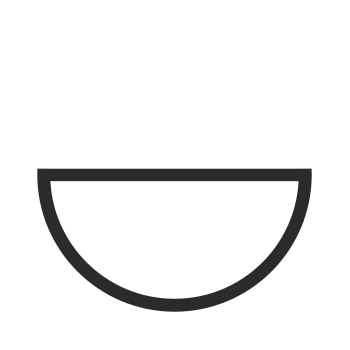
7. Lower Semicircle

Shape: Downward-opening
Symbol: AMA
8

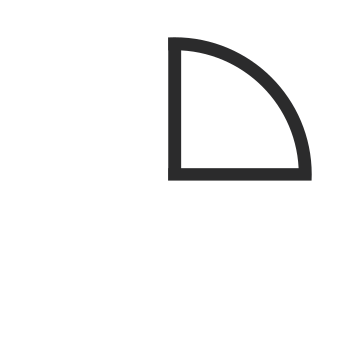
8. Upper Right Quarter

Shape: Upper right position
Symbol: KAMU-KAMU
9

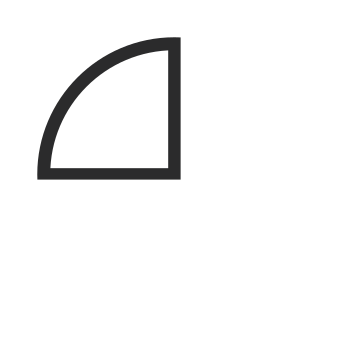
9. Upper Left Quarter

Shape: Upper left position
Symbol: AMA-KAMU
10

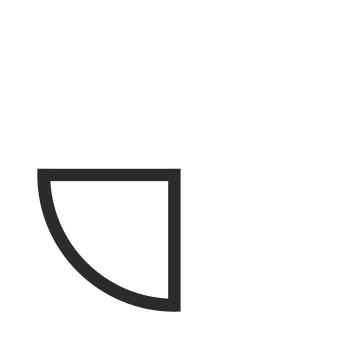
10. Lower Left Quarter

Shape: Lower left position
Symbol: AMA-AMA
11

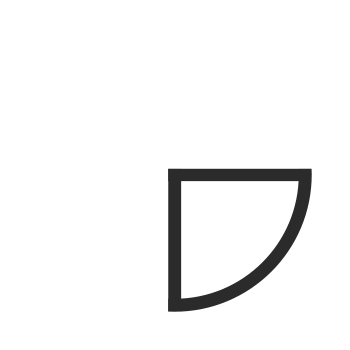
11. Lower Right Quarter

Shape: Lower right position
Symbol: KAMU-AMA
12

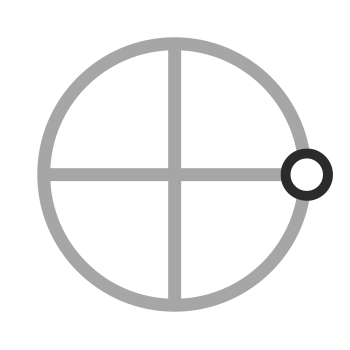
12. Small Circle (Right)

Shape: Right center
Symbol: 1
13

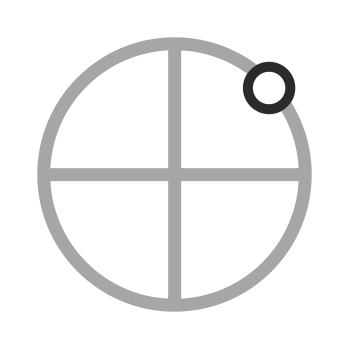
13. Small Circle (U-Right)

Shape: Upper right diagonal
Symbol: 2
14

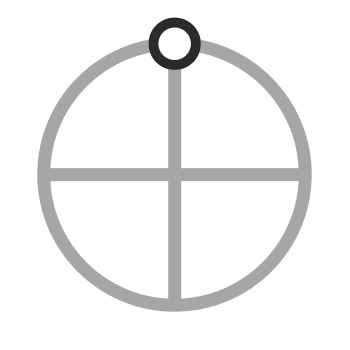
14. Small Circle (Top)

Shape: Top center
Symbol: 3
15

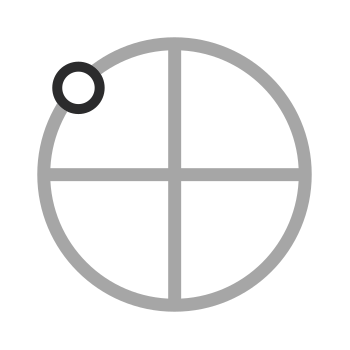
15. Small Circle (U-Left)

Shape: Upper left diagonal
Symbol: 4
16

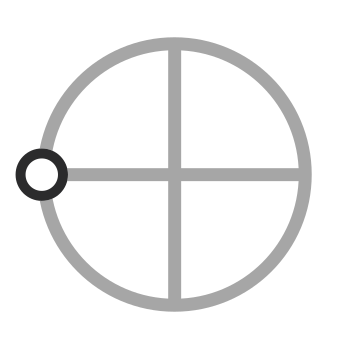
16. Small Circle (Left)

Shape: Left center
Symbol: 5
17

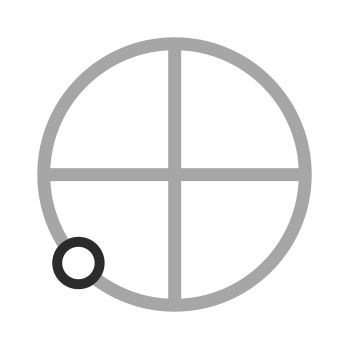
17. Small Circle (L-Left)

Shape: Lower left diagonal
Symbol: 6
18

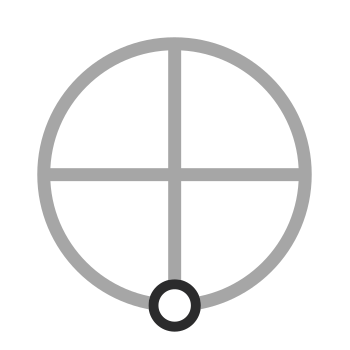
18. Small Circle (Bottom)

Shape: Bottom center
Symbol: 7
19

19. Small Circle (L-Right)

Shape: Lower right diagonal
Symbol: 8
20

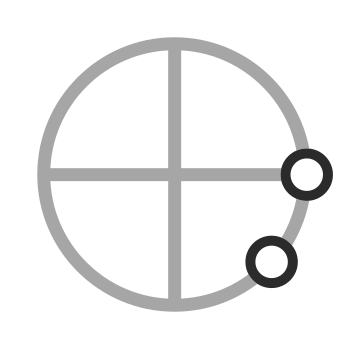
20. Two Small Circles

Shape: Pos. 1 and 8
Symbol: 9
21

21. Cross / Intersection

Shape: Vertical & horizontal
Symbol: 10
The Futo-mani Chart
A symbolic diagram of Katakamuna.
Futomani Symbol Integration

The Futomani Symbol

The Futomani symbol represents the structural integration of the 21 fundamental elements described above. Vertical and horizontal lines, combined with the circular arc elements, are arranged according to the geometric logic of AMA and KAMU.

The resulting figure is not ornamental. It is a geometric statement about the relationship between the latent and phenomenal dimensions — the same relationship that governs the structure of each individual sonic element in the Katakamuna system.

Reading the Futomani as a unified structure, rather than as a collection of parts, is the intended endpoint of the analytical process begun with the 21 elements.

上部へスクロール